An Excellent Throw happens when your Poké Ball lands inside the target circle while that circle is at its smallest. It pays out 1,000 XP and the largest catch bonus in the game, which is why it matters far more than the Nice and Great tiers below it.
This guide covers what the game actually awards for each throw tier, what the community has worked out about catch rates, and the technique for hitting Excellent throws on purpose instead of by accident.
Confirmed Throw Bonuses
When you press and hold the Poké Ball during an encounter, a colored circle appears over the Pokémon and shrinks. Your bonus depends on how small that circle is at the moment the ball lands inside it.
| Throw | Circle size on impact | XP awarded |
|---|---|---|
| Nice | Roughly 70% of full size or larger | 20 XP |
| Great | Roughly 30% to 70% | 100 XP |
| Excellent | Roughly 30% or smaller | 1,000 XP |
Two other bonuses stack on top of the throw tier:
- Curveball: 20 XP
- First Throw (you catch it with your first ball of the encounter): 50 XP
So a first-ball Excellent curveball is 1,070 XP in bonuses before your base catch XP. A Lucky Egg doubles all of it, and Catch XP events multiply it further — stacking a Lucky Egg with a Community Day’s bonus XP is one of the most efficient ways to burn through levels. During a 3x Catch XP event, the Excellent bonus alone becomes 3,000 XP; run a Lucky Egg at the same time and it reaches 6,000.
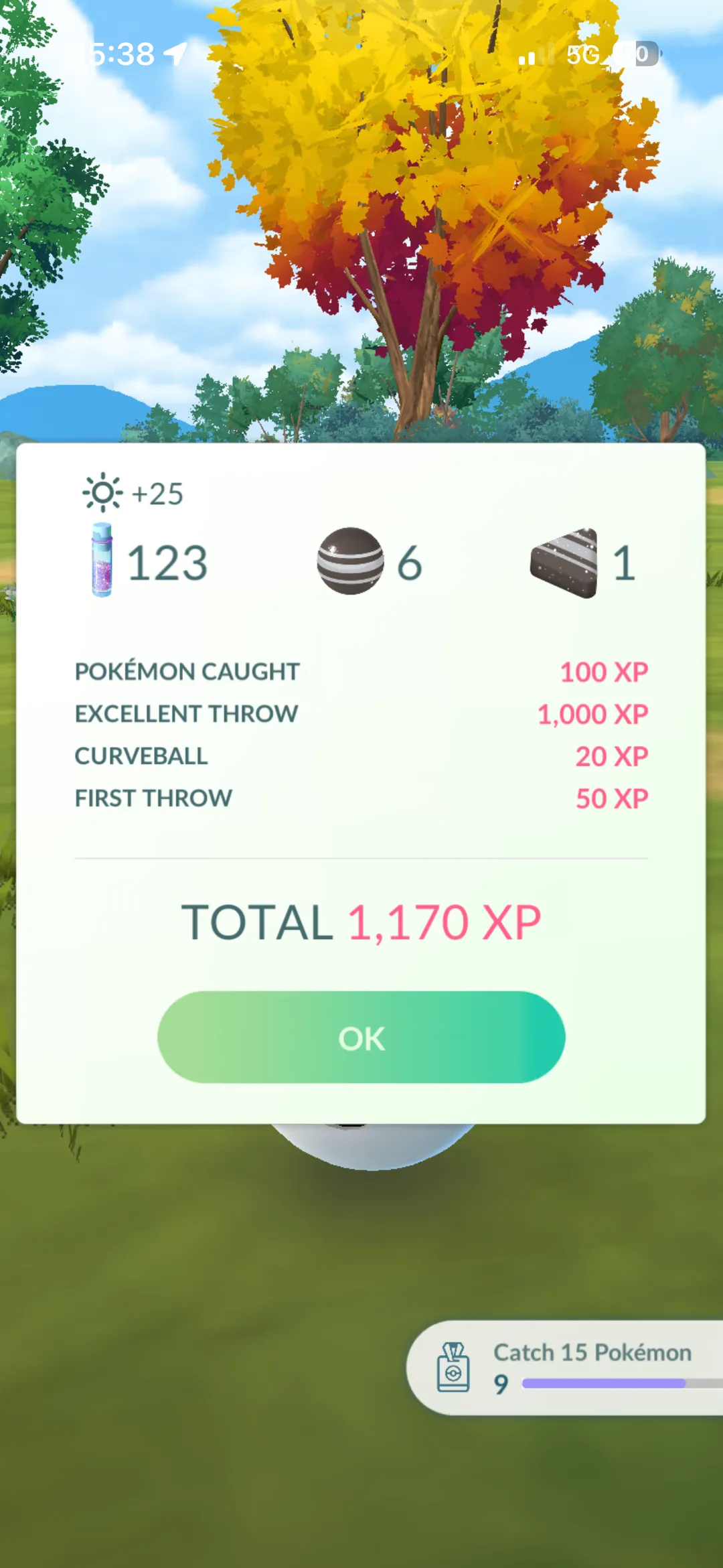
The October 15, 2025 leveling update rebalanced XP across the game. These values are current as of writing, but they are the kind of thing the developer adjusts, so confirm them in-game before planning a long grind session around them.
Community Observations: Catch Rate
The exact throw multipliers have not been officially published. Everything below comes from community reverse engineering of the catch formula, primarily by data-mining and tracking groups, so treat it as a well-supported estimate rather than official documentation.
The prevailing theory is that the throw bonus scales continuously with how small the circle is, rather than snapping to three fixed values:
- Nice: roughly 1.0x to 1.3x
- Great: roughly 1.3x to 1.7x
- Excellent: roughly 1.7x to 2.0x
Community researchers also place the curveball bonus at about 1.7x, and it appears to be a separate multiplier rather than part of the throw tier.
The important part is that these bonuses are believed to multiply rather than add. A curveball Excellent is not 1.7 plus 1.85, it is closer to 1.7 times 1.85, or a little over 3x, before berries and medals are applied. That compounding is why players who chase Excellent throws on rare encounters are not just doing it for the XP.
How to Land Excellent Throws Consistently
Use the circle lock
This is the technique most consistent throwers rely on, and it separates the timing problem from the aiming problem.
- Press and hold the Poké Ball without throwing.
- Wait for the circle to shrink to Excellent size.
- Release your finger without flicking. The ball drops and the circle stays at that size.
- Pick the ball back up and throw whenever you’re ready.
The circle no longer moves, so you only have to worry about hitting it.
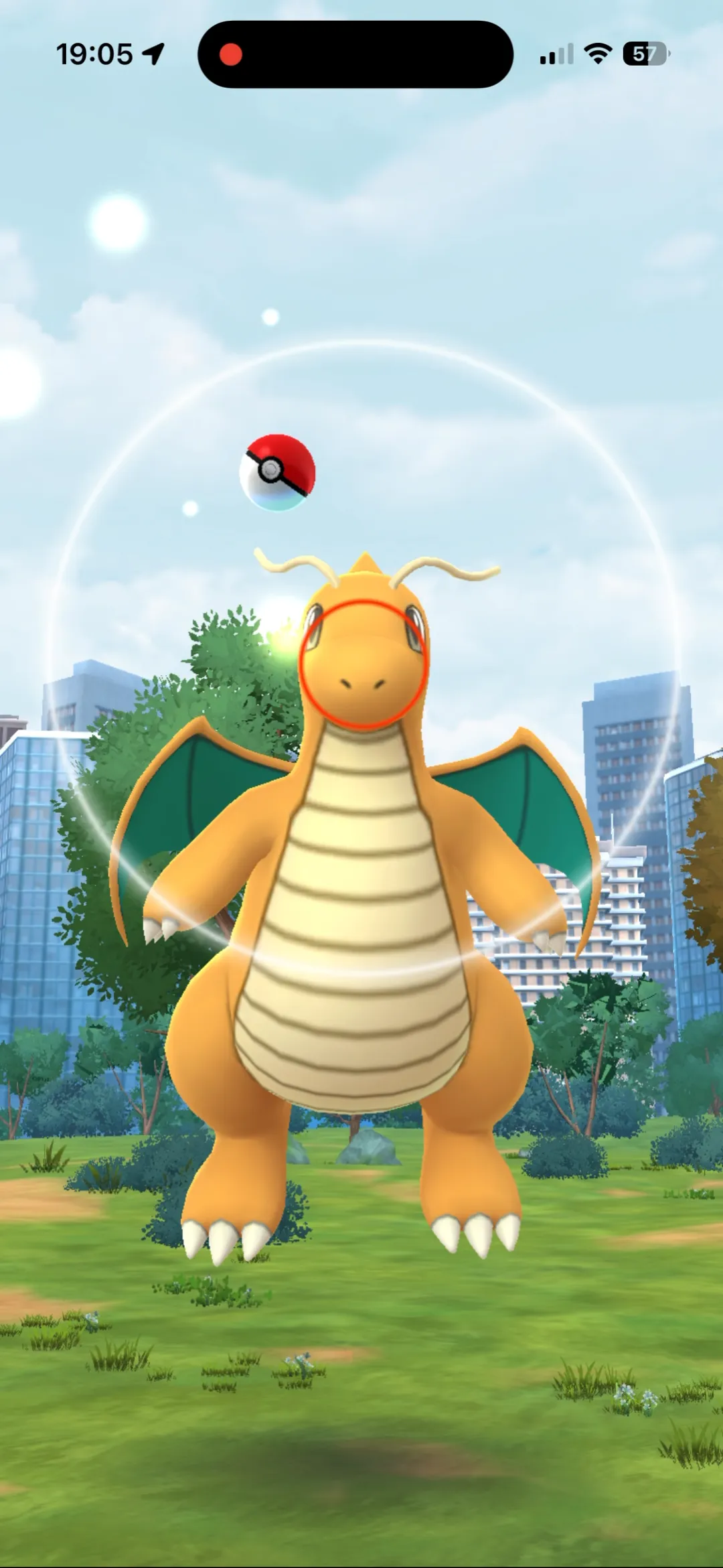
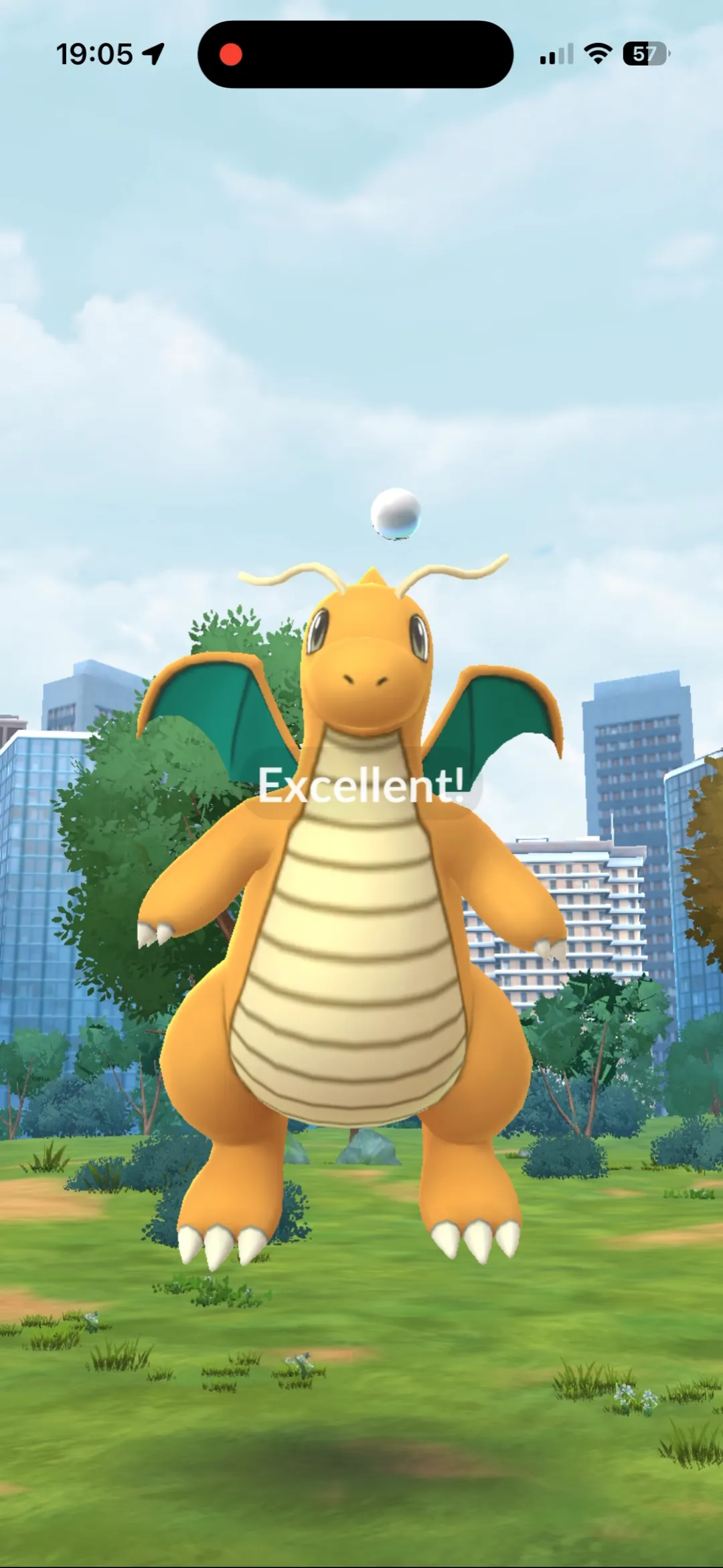
Locking the circle at Excellent size before releasing a curveball.
Time the arrival, not the release
Aim for the ball to reach the Pokémon just after it finishes an attack or jump animation, not during one. A ball that arrives mid-animation gets knocked away and is gone.
The practical version: watch the attack animation, and start your throw as it’s ending so the ball lands in the gap before the next one.
Throw curveballs by default
Spin the ball until it sparkles, then flick at roughly a 45-degree angle away from the spin direction so it arcs back into the center. It takes one or two quick circles to charge; over-spinning mostly ruins your release timing.
Once the curve is muscle memory, there’s little reason to throw straight. You’re leaving both the XP and the catch bonus on the table.
Feed a Nanab Berry to restless targets
A Nanab Berry slows a Pokémon’s movement and reduces how often it jumps or attacks. It doesn’t stop it entirely, but on a target that won’t sit still it buys you a wider window to throw into.
A worked example
Say a Shiny Eevee appears. You have one shot at this and a limited number of balls.
Feed it a Golden Razz Berry, hold the ball until the circle reaches Excellent size, drop it to lock that size in, then throw a curveball as the Eevee’s attack animation ends. Those bonuses compound: community estimates put that combination at several times the catch chance of a plain Nice throw, which often means the Eevee stays in the ball on the first or second attempt instead of the fifth. On an encounter you can’t repeat, that difference is the whole point.
Which Pokémon Are Easiest to Practice On
The easiest targets have large target circles and predictable movement.
| Target | Why it works |
|---|---|
| Wailmer, Snorlax, Ursaluna | Very large circles, centered on screen |
| Ponyta, Slowpoke, Tauros | Medium circles, rarely dart off-center |
| Oranguru | Large, stable circle and slow movement |
Common wild spawns are the right place to practice, because missing costs you one ball and nothing else. Raid bosses are stationary at a fixed distance, which does make the timing consistent, but you get a limited number of Premier Balls per raid. That’s an encounter to use the skill on, not to learn it on.
Common Mistakes
- Throwing during an animation. If the ball arrives while the Pokémon is attacking, it gets deflected. Wait for the gap.
- Aiming at the Pokémon instead of the circle. The circle isn’t always centered on the body; on some species it sits over the head or the belly. Throw at the circle and ignore the model.
- Misjudging depth. Flying and legendary Pokémon sit further back, and a throw calibrated for a Rattata at close range will fall short.
- Over-spinning curveballs. One or two rotations charges it. More than that just costs you the timing.
Your buddy can bail you out occasionally. A feature called Catch Assist is officially confirmed: when a Pokémon knocks your Poké Ball back at you, there’s a chance your buddy bounces it back at the Pokémon. Community reports place the unlock at the Great Buddy level. It’s a chance on an already-deflected ball, not a reason to throw carelessly.
Knowing Which Catches Were Worth the Throw
There’s a gap between landing Excellent throws and getting value out of them. Once you’re catching efficiently, you end up with a storage box full of the same species and no clear sense of which ones are keepers, which is a particular problem during Community Days and Spotlight Hours when you’re catching hundreds of the same Pokémon in a few hours.
That’s the part a tracker like GoDex handles. Scan a catch screenshot and it reads the CP and IVs, then shows how that specimen ranks for the Great, Ultra, or Little Cup, so you can tell in one pass which of the fifty you just caught are worth powering up and which are candy. You can also log which variants (Shiny, Lucky, Purified) you’ve filled in, so a long catching session doesn’t turn into an hour of sorting afterward.
Key Takeaways
- Lock the circle before you throw. Releasing the ball without flicking freezes the circle at Excellent size and turns a timing problem into an aiming problem.
- Throw curveballs every time. The extra 20 XP is minor; the catch bonus that stacks on top of your Excellent multiplier is not.
- Time the ball’s arrival to the gap after an attack animation, not to your own release.
- Practice on large-circle wild spawns like Wailmer or Slowpoke, and save the technique for raids and rare encounters where balls are limited.
- Stack a Lucky Egg with Catch XP events. A first-ball Excellent curveball is 1,070 XP in bonuses, and those bonuses multiply with event and egg boosts.

We do our best to keep these guides accurate, but Pokémon GO mechanics change often. If you spot a mistake or something that's out of date, please send us feedback — we'll fix it.

About GoDex
A free companion app for tracking your collection, scanning IVs from screenshots, and checking PVP rankings. Available on iOS and Android.

