See every boss in rotation today, with 100% CP and weaknesses, on the current Pokémon GO raids page.

Pokémon GO Mega Raids are Raid Battles against a Mega-Evolved boss. Beat one and you get Mega Energy for that species, plus a catch encounter with its ordinary, non-Mega form.
The mechanics around them changed more in the first half of 2026 than in the previous three years. Mega Raids now have their own entry currency, a harder tier sitting above them, and a fourth Mega Level. If your mental model of Mega Raids is “spend a Premium Pass, get some energy,” a few parts of this will be new.
This guide covers what the official announcements confirm, what the community has measured, and how to actually spend a raid session.
Confirmed Mechanics
These come from the Pokémon GO Help Center and the official pokemongo.com announcements.
The Three Kinds of Mega Raid
- Standard Mega Raids feature a Mega-Evolved Pokémon such as Mega Gengar, Mega Blaziken, or Mega Garchomp. They appear at Gyms from a distinct Mega Raid Egg.
- Mega Legendary Raids put a Legendary Pokémon’s Mega form in that slot. These are considerably harder and need a much larger group.
- Super Mega Raids launched in February 2026 alongside Pokémon GO Tour: Kalos, the same event framework covered in the GO Fest 2026: Mega Finale guide. The official announcement recommends at least eight Trainers, and every Trainer needs an active Mega-Evolved Pokémon in their party. The boss raises shields that only a Mega’s Charged Attack can break, with each Trainer able to break one. They appear only at selected Gyms and award substantially more Mega Energy than a standard Mega Raid.
How to Get In
Local entry accepts your free daily Raid Pass, a Premium Battle Pass, or Link Charges, the resource introduced in the February 2026 update. Link Charges currently cost 150 for a standard Mega Raid and 200 for a Super Mega Raid, and you can earn them from weekly challenges, opening Gifts, and checking in to community meetups through Campfire. The announcement states outright that Link Charges are better value than a Premium Battle Pass for in-person Mega Raids, so use them first and keep your Premium Passes for Legendary content.
Remote entry works differently by tier. A standard Mega Raid needs only a Remote Raid Pass. A Super Mega Raid needs a Remote Raid Pass and Link Charges.
For invites, you can select up to 5 friends at a time from the lobby, then invite more after a short cooldown. The daily remote raid cap has moved twice (5 per day in April 2023, raised to 10 in May 2025) and rises temporarily during some events, so check the current figure in-game rather than assuming.
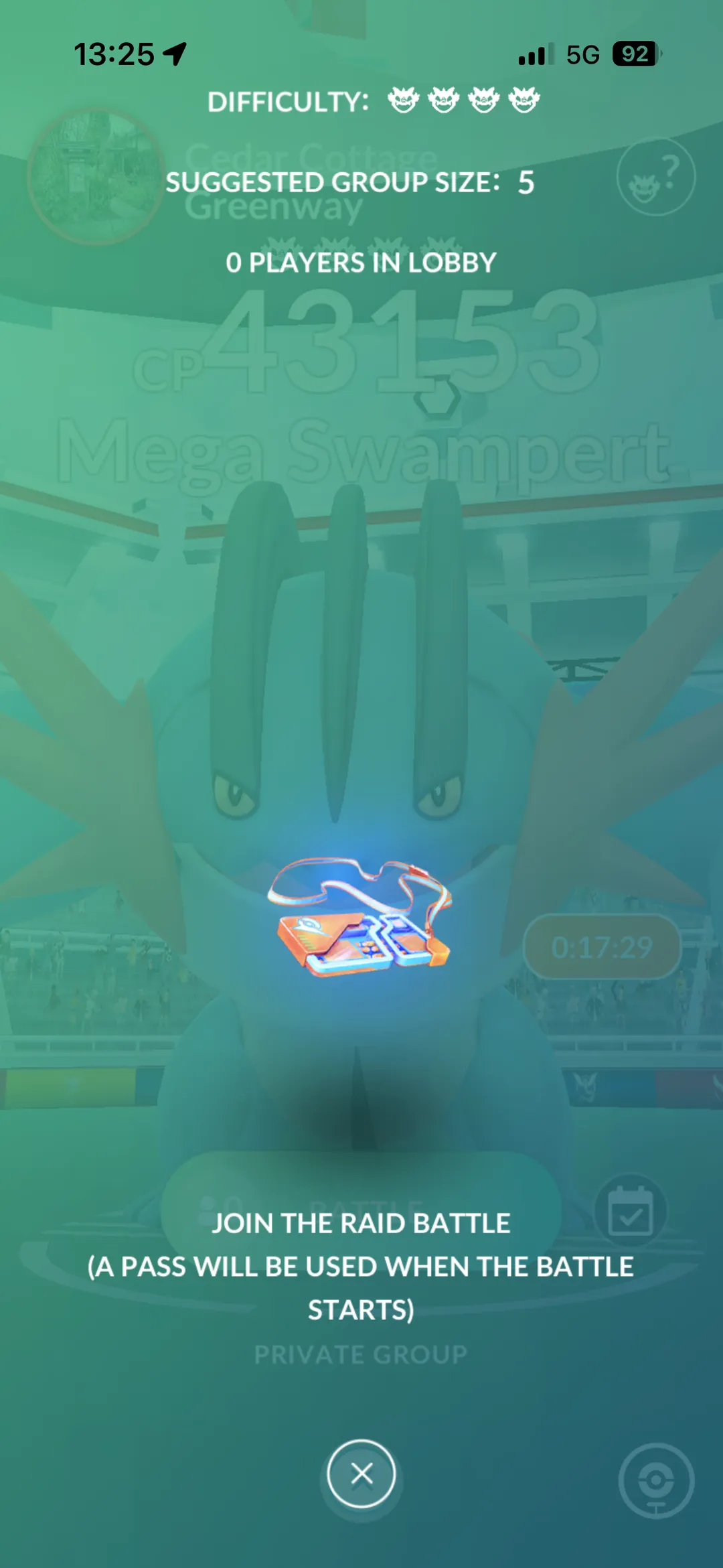
Link Charges live in a dedicated Link Holder item, and the raid lobby shows the Link Charge icon as one of the ways to join once you’re standing at the Gym:

How Mega Energy Works
Mega Energy is tied to a species, not shared across your account. One note from 18 May 2026: Pokémon with two Mega forms now use separate energy pools, so Charizard needs Charizard Mega Energy X for Mega Charizard X and Charizard Mega Energy Y for Mega Charizard Y.
The Help Center confirms that raid rewards are speed-based. After the fight you’ll see a Speed stat on the summary screen, and that stat determines how much Mega Energy you receive. Fast clear, more energy.
The first Mega Evolution of a given Pokémon costs the full energy price. After that, you can Mega Evolve it again for free once its rest period ends, or spend a reduced amount of Mega Energy to skip the wait. At Base Level the rest period is seven days, and it shortens as that individual Pokémon’s Mega Level rises.
Mega Levels
Mega Levels belong to the individual Pokémon, not the species. If you have two Charizard, each tracks separately. The tiers are Base, High, Max, and Super Max, the last added in February 2026. Higher levels shorten the rest period, cut the energy cost, and improve the catch bonuses you get while that Mega is active, including extra Candy and a better Candy XL chance for catching Pokémon that share its type.
A Pokémon’s detail screen shows the banked Mega Energy against the current cost to Mega Evolve, so you can see at a glance whether you have enough for another go:

What a Mega Does While Active
A Mega Evolution lasts eight hours, and only one Pokémon can be Mega Evolved at a time. Mega Evolving a second one immediately reverts the first, ending its timer. While active, a Mega raises the attack of every ally Pokémon in a Raid Battle, with a larger boost for moves sharing the Mega’s type.
Mega Pokémon can battle in Gyms, Raids, and Trainer Battles, but cannot be left to defend a Gym, traded, or powered up while Mega Evolved, and are generally excluded from GO Battle League outside specific events.
The Catch Encounter
You never catch the Mega form. Beat Mega Gengar and you enter a Bonus Challenge with an ordinary Gengar, which can be Shiny if that species’ Shiny has been released. Raid encounters have a guaranteed IV floor of 10/10/10, and the encounter is Level 20, or Level 25 if the boss’s type matched the weather.
What the Community Has Measured
The developer confirms these systems exist but doesn’t publish the underlying numbers. The figures below come from player tracking (Silph Road, PokémonGO Hub, community wikis), so treat them as well-supported estimates rather than official values.
- Mega Energy per raid: commonly reported at roughly 150 to 250 for a standard Mega Raid depending on clear speed. Super Mega Raids run substantially higher, with trackers reporting figures in the 350 to 450 range for the Mega Mewtwo raids at GO Fest 2026.
- The ally damage boost: widely measured at about +10% to all ally moves while a Mega is active, rising to roughly +30% for moves that share the Mega’s type. The boost does not scale with Mega Level.
- Shiny rate: community trackers place the Mega Raid catch encounter around 1 in 64, notably worse than the roughly 1 in 20 associated with 5-star Legendary bosses. Event-specific boosts can override this.
- Difficulty: GO Hub places standard Mega Raids around Tier 4 rather than at 5-star Legendary difficulty. Several frailer bosses, Mega Blaziken among them, are soloable by high-level accounts with strong counters and favourable weather.
How Many Players and What to Bring
Group size depends on the tier, your counters, and the weather, not on a fixed rule.
- Standard Mega Raids: 2 to 3 strong accounts with maxed super-effective counters, or 4 to 6 for a typical mixed group. Frail bosses can go down to one very well-prepared player.
- Mega Legendary Raids: plan for a full lobby.
- Super Mega Raids: eight Trainers minimum, all with an active Mega, and more than that for Legendary bosses.
A Worked Example
Say Mega Gengar is in rotation and you want its energy. Gengar is Ghost and Poison, so it’s weak to Ghost, Dark, Ground, and Psychic, and it hits hard but has poor bulk. Foggy weather boosts Dark and Ghost, which means your Tyranitar and your own Ghost attackers hit 20% harder, and it also boosts Gengar’s own Ghost moves, so expect to lose Pokémon faster.
You show up with four trainers instead of six. Before entering, one of you Mega Evolves a Mega Gengar or Mega Tyranitar, which raises everyone’s damage for the whole fight. If you’re physically together, form a Party Play group first, up to four Trainers at level 15 or above, and the Party Power gauge fills as you land Fast Attacks. Trigger it and every party member’s next Charged Attack does double damage.


The practical result: a four-person group that Mega Evolves and uses Party Power finishes noticeably faster than a six-person group that does neither, and because the Help Center’s Speed stat governs the payout, that faster clear means more Gengar Mega Energy for everyone in the lobby.
That’s the pattern worth internalising. Mega Raid rewards scale with how quickly you win, so preparation buys energy directly.
Are Mega Raids Worth Doing?
Yes, with one qualification. The first Mega Evolution for a species is the expensive one. Everything after it is either free after the rest period or heavily discounted, and an active Mega boosts every raid you join and every same-type catch you make for eight hours. That’s a permanent improvement to your account, so the cost is front-loaded.
The qualification is that Mega Energy is species-specific and the raid rotation moves. Committing to a Mega whose typing you rarely need means grinding several raids for a bonus you won’t use. Pick a Mega that fills a hole in your attacker lineup first.
Sorting What You Catch
A rotation you actually commit to leaves you with a stack of the same species. A few are keepers, such as a Shiny, a high-IV specimen for a PvP league, or a good candidate to Mega Evolve repeatedly for Mega Level progress. The rest are Candy. Working out which is which means opening each one, reading the appraisal, and remembering what you decided last time, which the in-game storage doesn’t help with across months of rotations.
A tracker like GoDex is built for that sorting step. You can scan a catch screenshot to read CP and IVs automatically, check how those IVs rank for the Great, Ultra, or Little Cup before deciding what to keep, and tag variants like Shiny or Lucky, including custom tags of your own. A short note on any Pokémon flags the one you’ve chosen to level up, so your Mega candidates don’t get lost.
Frequently Asked Questions
Do I need Link Charges to do a Mega Raid? No. In person you can use your free daily Raid Pass, a Premium Battle Pass, or Link Charges. Link Charges are the better value for standard Mega Raids. Super Mega Raids joined remotely are the one case where Link Charges are mandatory alongside a Remote Raid Pass.
Can you solo a Mega Raid? Some. Frailer standard bosses fall to a high-level account with strong counters and helpful weather. Mega Legendary and Super Mega Raids cannot be soloed.
Do I keep the Mega form of the Pokémon I catch? No. The boss reverts before the catch encounter, so you catch the base form and then need Mega Energy to Mega Evolve it yourself.
Can I get Mega Energy without raiding? Yes, but slowly. Some Field Research and Special Research award it, and walking a Buddy from a line you’ve already Mega Evolved earns it over distance.
Why did my Mega revert early? You Mega Evolved something else. Only one Pokémon can be Mega Evolved at a time, and starting a second ends the first one’s eight-hour window immediately.
Key Takeaways
- Use Link Charges for in-person Mega Raids and save Premium Battle Passes for Legendary raids.
- Speed sets the payout. Mega Evolve before entering and use Party Power if you’re raiding in person.
- Spend your first Mega Energy on a typing you’ll actually use, since the first evolution is the expensive one and every later one is discounted or free.
- Check the tier before committing. A standard Mega Raid is a small-group job, a Super Mega Raid needs eight Trainers who all have an active Mega.
- Re-verify the numbers. Link Charge costs, remote raid caps, and Mega Levels have all changed in the last year.

We do our best to keep these guides accurate, but Pokémon GO mechanics change often. If you spot a mistake or something that's out of date, please send us feedback — we'll fix it.

About GoDex
A free companion app for tracking your collection, scanning IVs from screenshots, and checking PVP rankings. Available on iOS and Android.

