When GoDex was ready to submit to the App Store, one line in the submission form stopped me cold: the Content Rights question. It asks, in plain terms, whether your app contains third-party content and whether you have the rights to use it.
For a Pokémon app, that’s not a throwaway checkbox. GoDex is full of Pokémon, including names, types, and stats. My early builds pulled in official creature artwork too, the same as most apps in the category. Sitting at that question, I had to decide what I was actually comfortable shipping.
This post is about what I found and the call I made, because it ended up changing the app for the better. One thing before I start, though: none of this is legal advice. I’m a developer sharing my own experience, not a lawyer. If you’re working through the same questions for your own project, please talk to a qualified attorney before relying on anything here.
What Most Pokémon Apps Do About Copyright
Browse the store and you’ll see a lot of Pokémon apps displaying official artwork, both inside the app and often right in their screenshots. Most carry a familiar disclaimer: unofficial, fan-made, no copyright infringement intended, used under fair use.
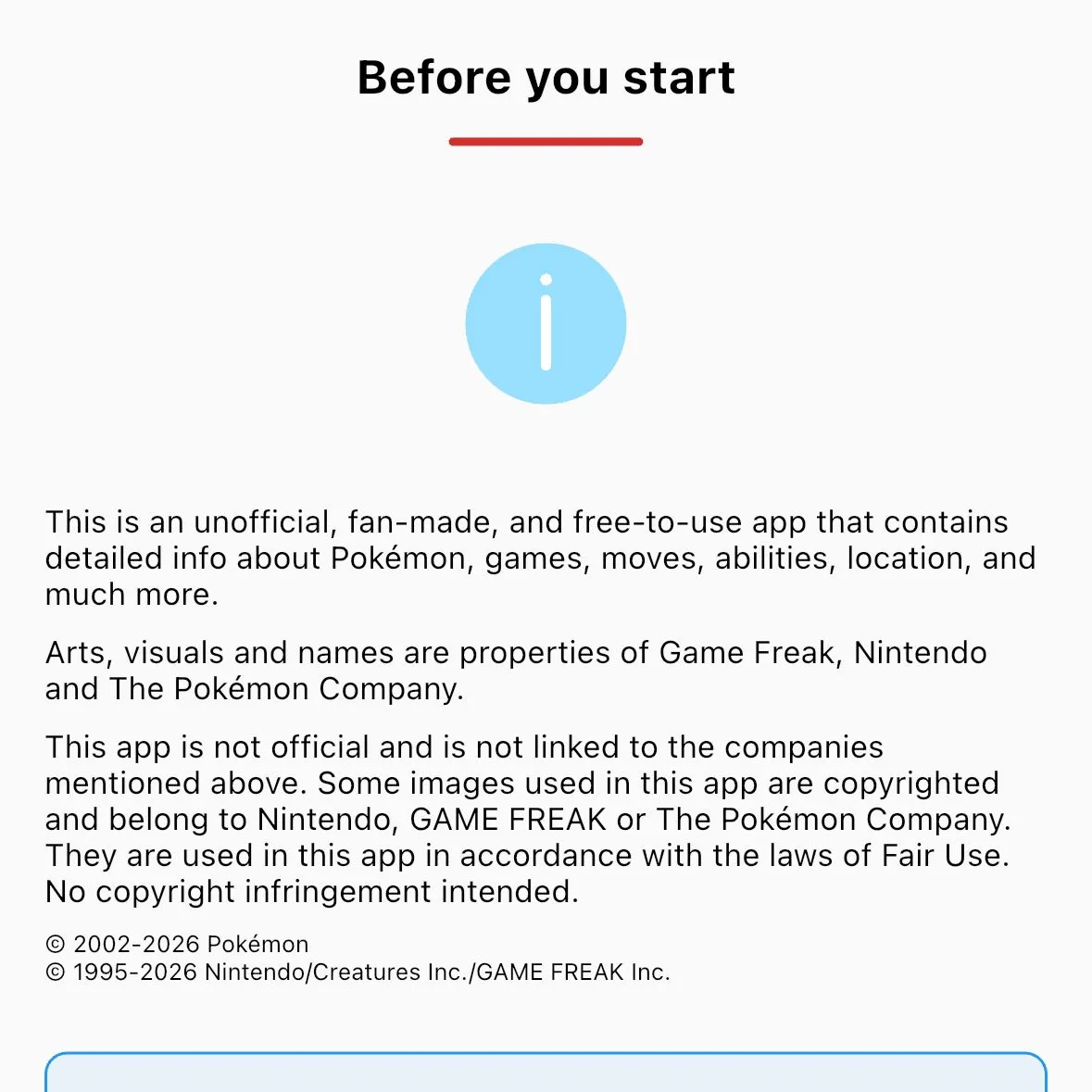
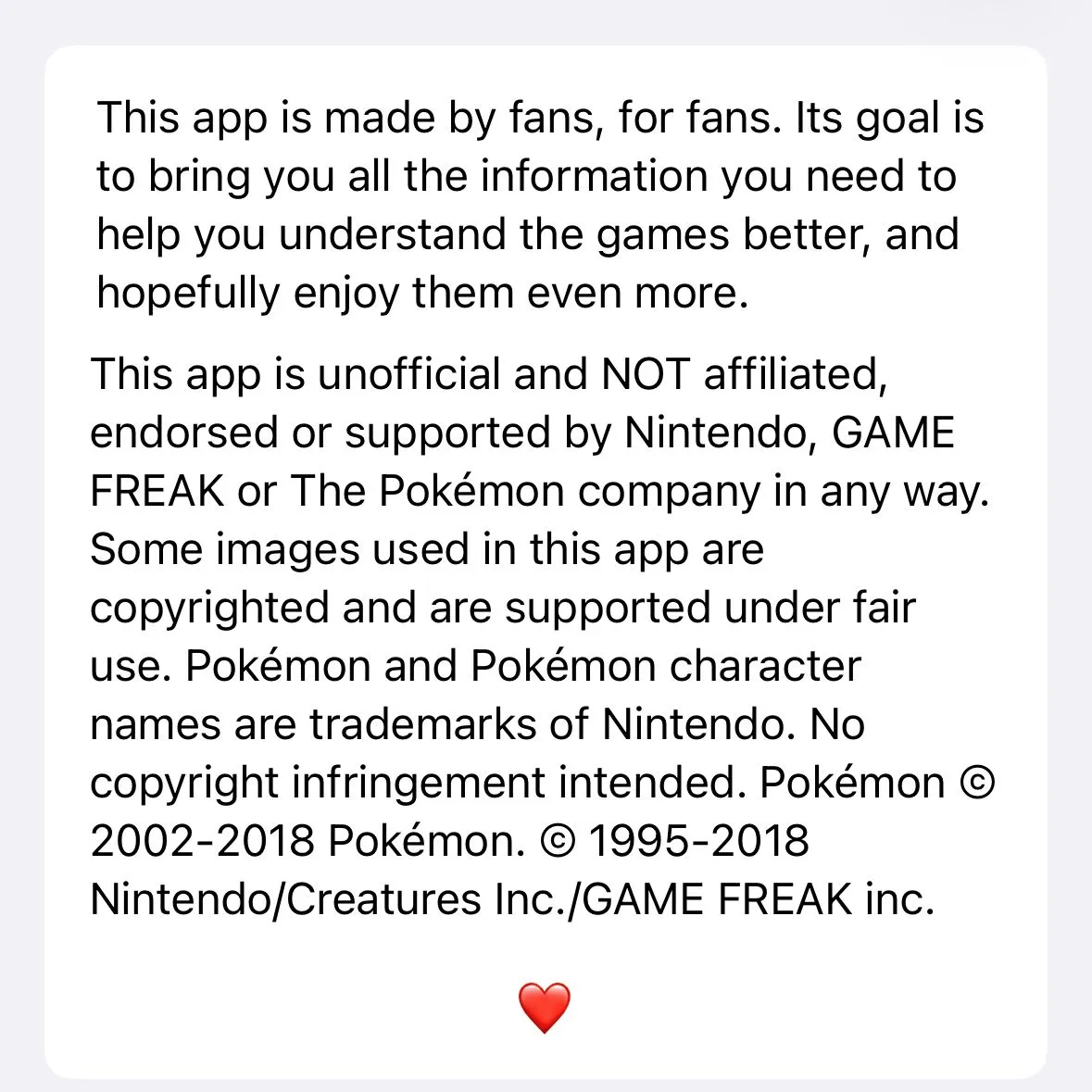
I read a lot of these, and again, I’m a developer, not a lawyer, but a few things were clear enough to act on. A disclaimer doesn’t grant you any rights; it’s a courtesy note, not a license. Fair use isn’t something you declare about your own app; it’s a defense a court weighs after the fact, and it tends to go badly for projects that copy characters and art wholesale. Displaying artwork you haven’t licensed is generally infringement whether or not you add a line saying you didn’t mean it.
So the apps doing this aren’t necessarily in the clear. For the most part they’re relying on the fact that enforcement is slow and selective. That’s a real bet, and plenty of small developers take it on purpose.
I Almost Just Shipped It Anyway
I’ll be honest: I came close to doing exactly what everyone else does. The official images made the app look finished, every comparable app on the store uses them, and those apps are still up. Realistically, the odds of anything happening to a small, one-person app are low. Enforcement is slow and selective, and I could probably have shipped with the art and been fine for a long time.
What changed my mind wasn’t the odds; it was the size of the downside. To get through review with the artwork, I’d have to answer that Content Rights question in a way that wasn’t true. And if a rights holder ever did file a complaint, it wouldn’t just be this one app getting pulled. A false attestation paired with an IP complaint can put your entire developer account at risk, potentially affecting every app on it rather than just the one that caused the problem. (Again, not legal advice, just the risk as I understood it.)
So the real question wasn’t “will I get caught.” It was whether a small chance of losing my whole developer account was worth the convenience of borrowed images for a single app. Put that way, it wasn’t close. I didn’t want the app’s existence to depend on never being noticed, and the account is worth far more than the shortcut.
What I Changed
The fix started by splitting the app’s content into two very different buckets.
The first is data, which includes names, types, base stats, and the CP and IV formulas. This is factual game information, and it’s what actually powers the parts of GoDex people use: the IV scanner, the PvP rankings, and the stats calculator. I pull it from public data sources.
The second is artwork, specifically the official creature renders. This is the part that’s plainly owned by someone else, and it’s the part I removed.
GoDex now ships with no bundled or fetched Pokémon artwork at all. The factual data does the heavy lifting, and the app’s visual identity comes from type colors and my own design instead of official renders. The principle underneath the decision is a simple one: content a user brings in themselves is a very different thing from content the app hands out to everyone. Anything you add yourself is yours to add. So rather than distributing images I don’t own, I built the app to be filled by you.
Where I’d Like to Take It Next
Removing the official art also opened up an idea I think is more fun than what it replaced, though to be clear, this part isn’t in the app yet. It’s a direction I’m excited about, not a shipped feature.
GoDex already reads your in-game screenshots to pull a Pokémon’s IVs. A feature I’d love to add down the line: optionally cropping the Pokémon out of that same screenshot, on your own device, so your dex fills in with photos of your own catches instead of stock sprites.
Picture a living dex, which is a field journal you build yourself. The grid would start as undiscovered slots, each showing a Pokémon’s name, number, and a type-colored hint but no image yet. Scan a catch, and the slot develops into your own photo of the Pokémon you just caught. The empty spaces would pull you forward the same way a blank Pokédex always has, and every filled entry would be genuinely yours, not a sprite identical to the one in every other app. That’s the kind of thing user-supplied content makes possible, because the images come from you rather than from me.
For now, the app stands on its own work. The scanner, the rankings, the calculators — that’s what I built, and it’s what GoDex is really for. The borrowed art was never the point.
If You’re Building Something Similar
A quick, non-lawyer summary of what I took away, in case you’re weighing the same question:
- The App Store Content Rights question is about whether you hold rights to third-party content. A disclaimer doesn’t answer it for you.
- Game data and official artwork are not the same risk. Names, types, and stats are factual; the character art is owned.
- Pulling data from public sources, keeping official art out, and leaning on your own design let me answer that question honestly, since there is no bundled art to account for.
- Weigh the downside, not just the odds. Getting caught may be unlikely, but a problem tied to a false content-rights answer can reach your whole developer account, not just one app.
- User-supplied content is a different category. What a person brings in themselves opens up features you can’t build on borrowed assets, such as a dex that could one day fill with your own catch photos.
If a Pokémon tracker that stands on its own (featuring your data and collection without borrowed art) sounds like what you want, GoDex is built that way.

About GoDex
A free companion app for tracking your collection, scanning IVs from screenshots, and checking PVP rankings. Available on iOS and Android.

